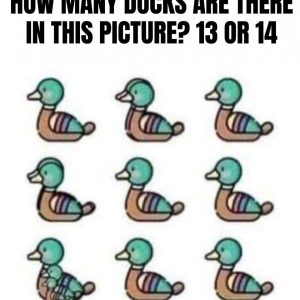
At first glance, the image appears simple and playful—rows of cartoon monkeys arranged in a neat pattern, inviting nothing more than a quick look. But then the bold statement at the top catches your attention: “The number of monkeys you see determines if you’re a narcissist.” It’s a striking claim, the kind designed to make you pause and engage. Almost instantly, you begin counting, curious not only about the answer but about what it might reveal about you.
As you look closer, something interesting begins to happen. Some people quickly count a fixed number of monkeys, seeing only the obvious shapes. Others, however, start to notice additional details—smaller monkeys hidden within larger ones, slight differences in positioning, or overlapping elements that weren’t immediately visible. What seemed straightforward becomes more complex, and the number you counted may suddenly change. This simple shift raises a deeper question: why do different people see different things in the same image?
The answer lies in how human perception works. Our brains are not passive recorders of reality; they actively interpret what we see. Every moment, the brain filters information, deciding what is important and what can be ignored. This process is influenced by past experiences, expectations, attention levels, and cognitive shortcuts known as heuristics. Because of this, two people can look at the same image and walk away with completely different interpretations.
In visual puzzles like this, some individuals naturally focus on the bigger picture. They identify the main shapes quickly and move on, satisfied with what they see. Others take a more detailed approach, scanning the image more carefully and picking up on subtleties that are easy to miss. Neither approach is right or wrong—it simply reflects different ways of processing information. One prioritizes efficiency, while the other emphasizes depth and precision.
Despite the intriguing claim in the caption, there is no scientific evidence linking the number of monkeys you see to narcissism. This type of statement is a common example of viral psychology bait—content designed to grab attention and encourage sharing. By attaching a bold or slightly controversial idea to a simple image, it creates curiosity and invites people to test themselves, even if the conclusion has no real psychological basis.
That said, the image can still reveal something meaningful, just not what it claims. It highlights your observation style. If you see fewer monkeys, you may naturally focus on the overall structure, filtering out smaller details. If you see more—including hidden or overlapping shapes—you might have a more detail-oriented mindset, noticing patterns others overlook. These tendencies reflect cognitive preferences rather than personality traits like narcissism.
Part of the appeal of these illusions is how they tap into basic human instincts. Curiosity drives you to look again and question your initial answer. Self-reflection makes you wonder what your perception says about you. And comparison encourages you to check what others see, turning a simple image into a shared experience. This combination is what makes such content spread so easily and feel engaging.
Ultimately, the real takeaway is not about labeling yourself, but about understanding how perception works. What we see is not always complete, and first impressions can miss important details. Sometimes, taking a second look reveals something new—not just in images, but in everyday situations as well.
So when you look again, the question isn’t really about monkeys. It’s about awareness. And maybe, just maybe, what you notice the second time tells you more than what you saw at first glance.